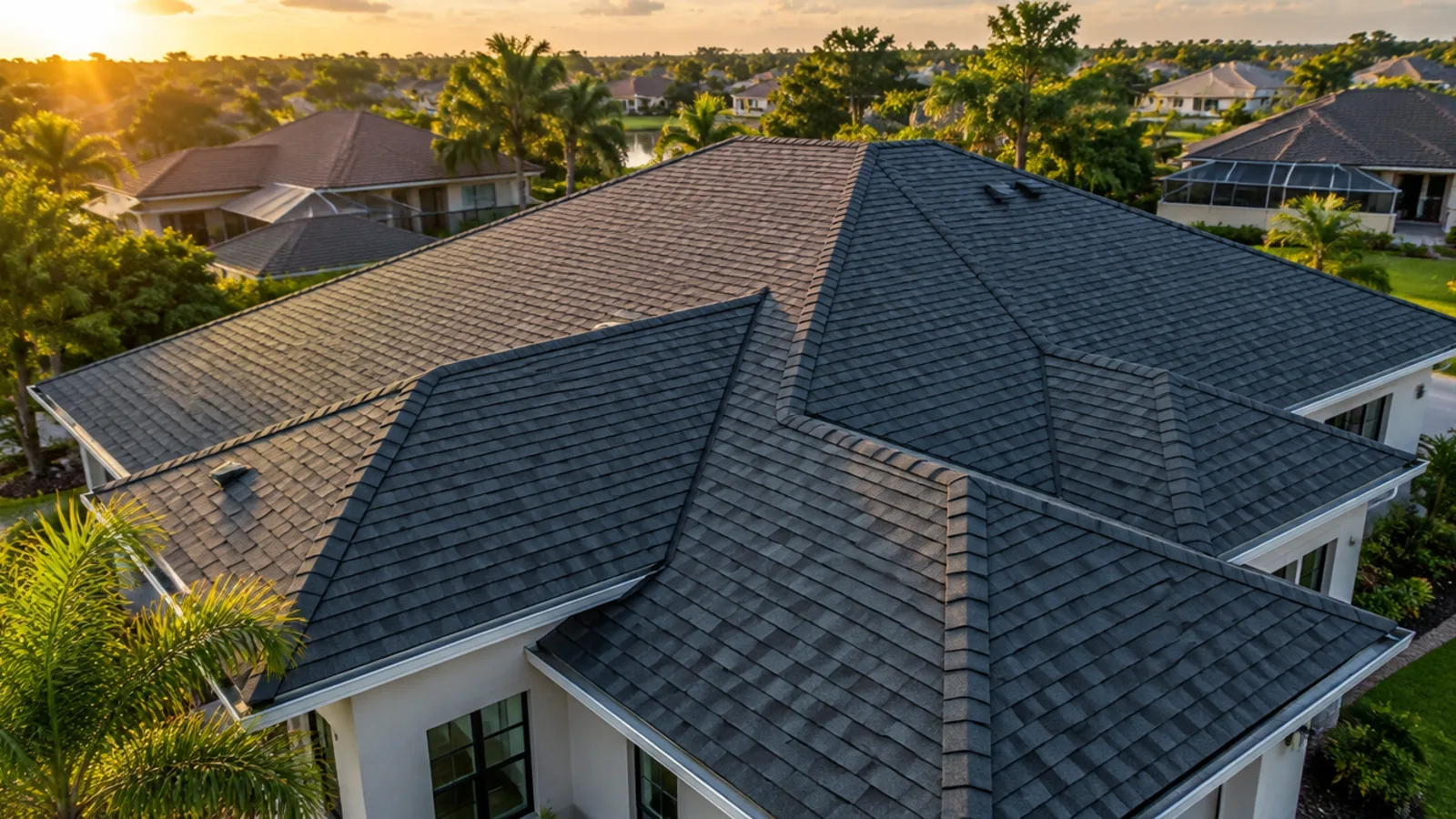
How long it takes and what happens in what order
A straightforward single-story roof takes under an hour. A complicated roof line with several slopes, multiple valleys, a chimney and a lanai tie-in takes longer, because every joint is a separate thing to look at. A tile roof takes longer again, because getting around on it has to be done carefully.
The order is usually the same. A walk around the outside first, looking along the plane of each slope rather than straight at it, because a dip or a sag shows up from the side and disappears head on. Then the ground: granules collecting at the downspouts, cracked tile fragments, anything that has come off and not been noticed.
Then up. Penetrations first, because vent boots and anything else coming through the covering fail more often than the rest of the roof combined. Flashing second, at every point where the roof meets something vertical. Edges, corners and perimeter metal next, because uplift starts at the edge. Valleys, and then the field of the roof, which is the least likely place to find anything.
Then the attic, with a flashlight, looking for dark staining, salt lines, rust on nail points and truss plates, and compacted or discolored insulation. The attic is where the history is. A patch of insulation that has been wet repeatedly looks different from one that got wet last week.
Then the part that matters most, which is somebody standing in your driveway going through the photographs with you before they leave.
Looking along the plane of a slope shows you a dip that disappears when you look straight at it.
Whether anyone actually walks the roof
Yes, where the roof can be walked safely and walking it will not damage it. That is the only way to see a lifted shingle that has settled back down, a fastener that has backed out, or decking that is soft in a patch. None of that is visible from a ladder at the eave and none of it is visible from the ground.
There are roofs we do not walk. Tile breaks under foot in ways that turn one repair into two, so on tile we work from the edges and the valleys and keep off the field where we can. A wet roof does not get walked at all. Low-slope and coated systems on manufactured housing get walked differently, with attention to seams and terminations rather than individual pieces of covering. A roof with a soft deck does not get more weight on it than it has already had.
Where the roof cannot be walked, it gets inspected from a ladder at the perimeter, from the attic underneath, and with a camera on a pole. That is a real inspection and it has real limits, and the report should say which parts were reached that way rather than quietly imply the whole roof was underfoot.
You should not go up. Wet Florida roofs are slippery, tile breaks underfoot, and a fall from one story does serious harm. Almost everything you can usefully check yourself is on the ground or in the attic.
The photographs you should receive
A photograph of every defect, taken where the defect is. Not a general shot of the roof from the driveway with an arrow on it. If an item is described in the report, there should be a picture of that item attached to that description.
Photographs of the things that are sound, too. A report containing only faults does not tell you whether the rest of the roof was looked at. If the boots are good and the flashing is good, that deserves a picture, because next year you will want to compare.
Wide shots of each slope and each elevation, so the close-ups have somewhere to sit. A close photograph of a split vent boot tells you nothing about where on the roof that boot is.
Attic photographs where there is anything to see. Staining on the underside of the deck, a rusted truss plate, a dark ring around a penetration.
And they should be yours to keep, in a form you can forward. Photographs you can only view on a tablet in your driveway are not documentation. Ours go to you and you can send them to anyone you like, including another roofer.
Photographs you can only see on somebody else's tablet are not documentation.
What the written report should and should not say
It should say what each item is, where it is, and what putting it right involves, in plain language. A list of locations and conditions. Not a grade, not a score out of ten, and not a single line saying the roof needs replacing.
It should separate the acute failures from the general wear. Those are two different findings and they lead to two different decisions. A roof with one split boot and a roof with granule loss across every slope are not the same roof, and a report that merges them into one recommendation has done you no favor.
Where both a repair and a replacement are genuinely real options, it should contain both, separately, so you can compare them yourself rather than take anyone's word for which you need. Where only one is real, it should say which and say why, with a photograph attached to the reason.
It should say what was not reached. A roof section nobody got onto, a flat area over an addition, decking that was not opened. The limits of an inspection are part of its findings.
It should not tell you how many years the roof has left. An honest figure for a specific roof does not exist, because installation quality, attic ventilation and sun exposure pull in different directions, and two roofs put on the same week on the same street end up in different condition. It should not tell you what your carrier will do either, because we do not know. That is between you and your carrier.
What we do not do on an inspection
We do not complete or sign wind mitigation inspections or four-point inspections. Those are separate forms about construction features and insurance credits rather than about roof condition, and Florida Statute 627.711(2) sets out who may complete the wind mitigation one. Roofing is its own contractor category and is not on that list. If you booked us expecting that form, we will tell you on the phone rather than on the day.
We do not file insurance claims, attend on your behalf, or predict what a carrier will decide. What we can hand you is a dated condition report with photographs, which is a record rather than a prediction and more use than one.
We do not quote before looking at the roof, over the phone or from a photograph you send. Roofs that look identical from the street are in different condition, and a number given sight unseen is either padded or about to change.
We do not ask anyone to sign on the day. The document goes with you, and you can take it to a credit union, to your family, or to another roofer. It is yours.
And when the finding is that the roof is fine, that is the finding. You get the same written record either way, and it is worth keeping. Work performed by GenX Roofing LLC, Florida Certified Roofing Contractor, license CCC1333347.