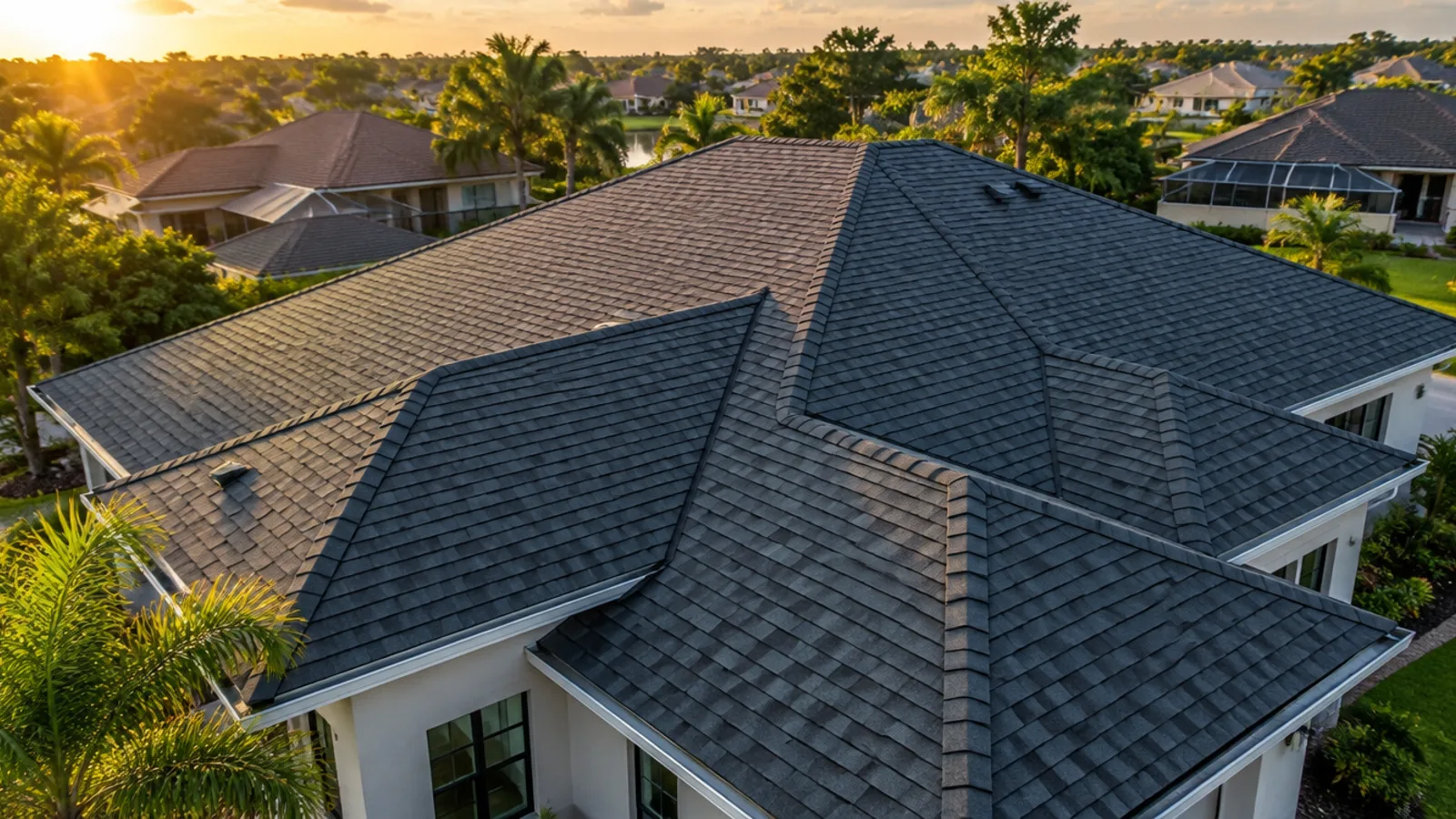
The field of the roof is rarely the problem
The plain sloped area of a roof is the part best built for its job. Each shingle or tile laps over the one below, water runs straight down, and nothing is in the way.
Leaks start where that pattern is interrupted. A pipe comes through. Two slopes meet. The roof runs into a wall or a chimney. A nail sits where it should not. Every one of those is a joint, and joints are where water gets a chance to go somewhere other than downhill.
That is why the ceiling stain tells you so little. It shows where the water came out, not which joint let it in. The joint is usually uphill, and it can be well off to one side.
Leaks start where the pattern is interrupted. Every interruption is a joint.
Valleys and dead valleys
A valley is where two roof slopes meet in a channel. It collects the runoff from both sides, so it carries far more water than any other part of the roof. A small weakness that would never matter on the open slope shows up fast in a valley.
The usual failures are worn or cracked valley metal, shingles cut too short along the valley edge, and nails driven too close to the center of the channel. Any of those gives a sheet of moving water a way under the covering.
A dead valley is different. It is a spot where a slope runs into a wall or another roof plane and the water has nowhere clean to go. Behind a chimney, where a dormer meets the main roof, where a lanai roof ties in below a second story. Water slows down there and sits.
In Florida, dead valleys fill with oak leaves and pine needles. That debris holds water against the roof long after the rain stops. It also dams the flow, so water backs up under the laps instead of running off. A dead valley that stays dry all spring can be the whole problem once the summer rains start.
Pipe boots and other penetrations
Every plumbing vent that comes through the roof has a boot around it. The boot is a flashing base with a rubber collar that seals around the pipe. The base tucks under the shingles above it and sits on top of the shingles below it.
The rubber is what fails. Sun hardens it, it cracks around the pipe, and water runs down the outside of the pipe into the attic. From the ground the boot looks intact. The crack is usually on the uphill side, where nobody can see it.
The nails holding the boot base can lift too, and some boots were sealed with exposed caulk that has since dried out. Exhaust vents, roof vents and satellite mounts fail the same way. Anything that puts a hole in the roof has to be sealed around, and that seal wears out faster than the roof around it.
A boot leak often shows in the attic as a dark ring on the underside of the decking around the pipe, or a wet streak running down the pipe itself.
Chimney, skylight and wall flashing
Where a sloped roof meets something vertical, the joint is covered with flashing. Step flashing is a series of small bent pieces woven in with each course of shingles along a wall or chimney. Counterflashing covers the top edge of the step flashing and is set into the wall, the mortar joint or behind the siding.
Leaks here come from a handful of places. Step flashing that was left out, or reused from an old roof. Counterflashing that has pulled out of the mortar. Sealant used in place of flashing, which hardens and cracks in this heat. Siding or stucco run down onto the roof so water gets behind it.
Chimneys add a back side. Water coming down the roof hits the uphill face of the chimney and has to be turned around it. Without a cricket, a small peaked diverter built behind the chimney, that face becomes a dead valley and holds water and debris.
Skylights have flashing on all four sides plus their own seals and frame. A skylight can leak at the roof flashing, at the curb, or through the unit itself. A stain under a skylight is not always a roof problem, and it is worth knowing which before anyone starts replacing parts.
Nail pops
A nail pop is a roofing nail that has backed out of the deck and pushed up into the shingle above it. It lifts the shingle, breaks the seal, and sometimes pokes through.
The cause is usually movement. Decking expands and contracts with heat and moisture, and a nail that missed the framing or went in crooked works loose over time. Florida attics run hot, so that cycle never really stops.
Nail pops are hard to see from the ground and easy to miss from the attic. One pop is a small leak. A roof with a lot of them is telling you something about how it was nailed, and that is worth a closer look by someone who can safely get up there.